Unveiling the Silk Road’s Legacy: How Ancient Trade Routes Shape Today’s Cultural and Artistic Ties
A Scholar-in-Residence at Columbia Global Center Beijing discusses his residency and how he plans to create opportunities for Columbia students.
Has the legacy of the fourth-century Silk Road continued to influence global culture and trade today? In 2025, Columbia Global launched its first Scholars-in-Residence cohort, inviting full-time faculty to spend two to eight weeks at one of our Columbia Global Centers. The program provides support for travel, lodging, workspace, and project development, and encourages building partnerships with local institutions.
Jin Xu, Associate Professor of Archaeology & Art History at Columbia University, spent a month at Columbia Global Center Beijing. In this Q&A, he reflects on the focus of his residency, the collaborations it enabled, and his plans to expand opportunities for Columbia students.
Q1: What was the main focus of your residency this time at the Beijing Global Center?
Xu: My residency centered on advancing both teaching and research in Silk Road studies, with a particular focus on laying the groundwork for an immersive study trip on the imperial architecture of the Qianlong reign—an era that reshaped Beijing’s cityscape and deepened artistic exchanges between China, Central Asia, and even Europe.
To fully understand this cultural and political legacy, I organized in-depth field trips around Beijing and its outskirts to plan the itinerary and gather firsthand insights for students’ upcoming journey. These visits helped me identify key sites—palaces, gardens, temples—that will serve as vital learning opportunities for students to experience China’s imperial legacy firsthand. This process has been crucial in designing a course that will bring history vividly to life and foster a deeper understanding of how architecture reflected the empire’s ambitions and its role in shaping diplomatic relations along the Silk Road.
Parallel to teaching, I advanced research on the Northern Wei Dynasty (386–534), examining relics like stone steles and inscriptions—many of which I meticulously studied in archival collections in Beijing—contributing to a book project that explores the dynastic origins of Chinese culture and its outward influences.
Q2: What research achievements did you accomplish during your residency?
Xu: I made significant progress on my research by completing the first draft of my second book manuscript, which investigates the rich imagery of Northern Wei stone steles and their role in cultural exchange along the Silk Road. I also secured a publication deal with one of China’s major bookstore chains, Sanlian Press, to translate my upcoming book, The Silk Road with Many Faces, into Chinese, broadening its impact. Additionally, I advanced my research on the ancient relics and inscriptions, with plans to publish an academic article based on fieldwork conducted in Luoyang, Taiyuan, and Shijiazhuang, further contributing to our understanding of early medieval China’s art and diplomacy.
Q3: How did the residency facilitate collaborations?
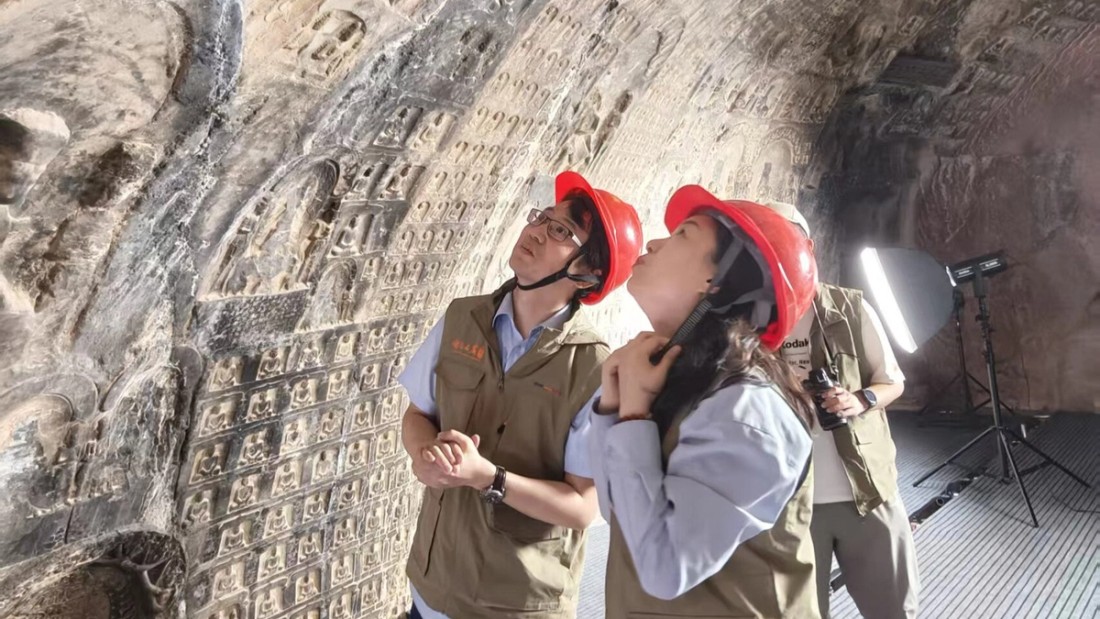
Xu: The residency was a gateway to meaningful collaborations with Chinese scholars and institutions. I met with Professor Sun Jing at Tsinghua University to plan future student exchanges, which will enrich Columbia’s programs. Visiting the Luoyang Institute of Archaeology and the Longmen Grottoes, I was honored to be appointed as a member of their academic committee—an endorsement of the trust and shared commitment to Silk Road studies. I also delivered a speech at the International Gandharan Art Conference hosted by Zhejiang University, further strengthening academic ties and sharing insights on cross-cultural art exchanges along the Silk Road.
Q4: What role did the Beijing Global Center play in supporting your work?
Xu: The Beijing Center’s support exceeded my expectations. It provided excellent facilities and a vibrant environment for scholarship, along with invaluable opportunities for networking. The Center served as a vital platform for fostering academic and cultural exchange, helping me connect with Chinese scholars, publishers, and officials. I believe its role as a bridge—connecting Chinese and international scholars—can be expanded further. It is essential not only for individual projects but also for strengthening global collaborations in fields like Chinese art, history, and Silk Road studies.
Q5: What are your plans after this residency?
Xu: I plan to offer a travel seminar for Columbia students in Spring 2026, in partnership with the Beijing Global Center. I am also exploring the possibility of developing summer programs similar to those Columbia conducts in Paris and Venice, using the Center as a hub for workshops and research dissemination. Ultimately, I hope this residency marks the beginning of ongoing academic exchanges that continue to build bridges between China and the broader international scholarly community.
